
Castles1563 – 1584Komaki, Aichi Prefecture
Before Azuchi
Komakiyama Castle and the Evolution of Oda Nobunaga's Political Landscape
A field-based history essay on Komakiyama Castle, the missing Gifu stage, and the changing political architecture of Oda Nobunaga.
10 September 2026Noah Schuster · 11 min read
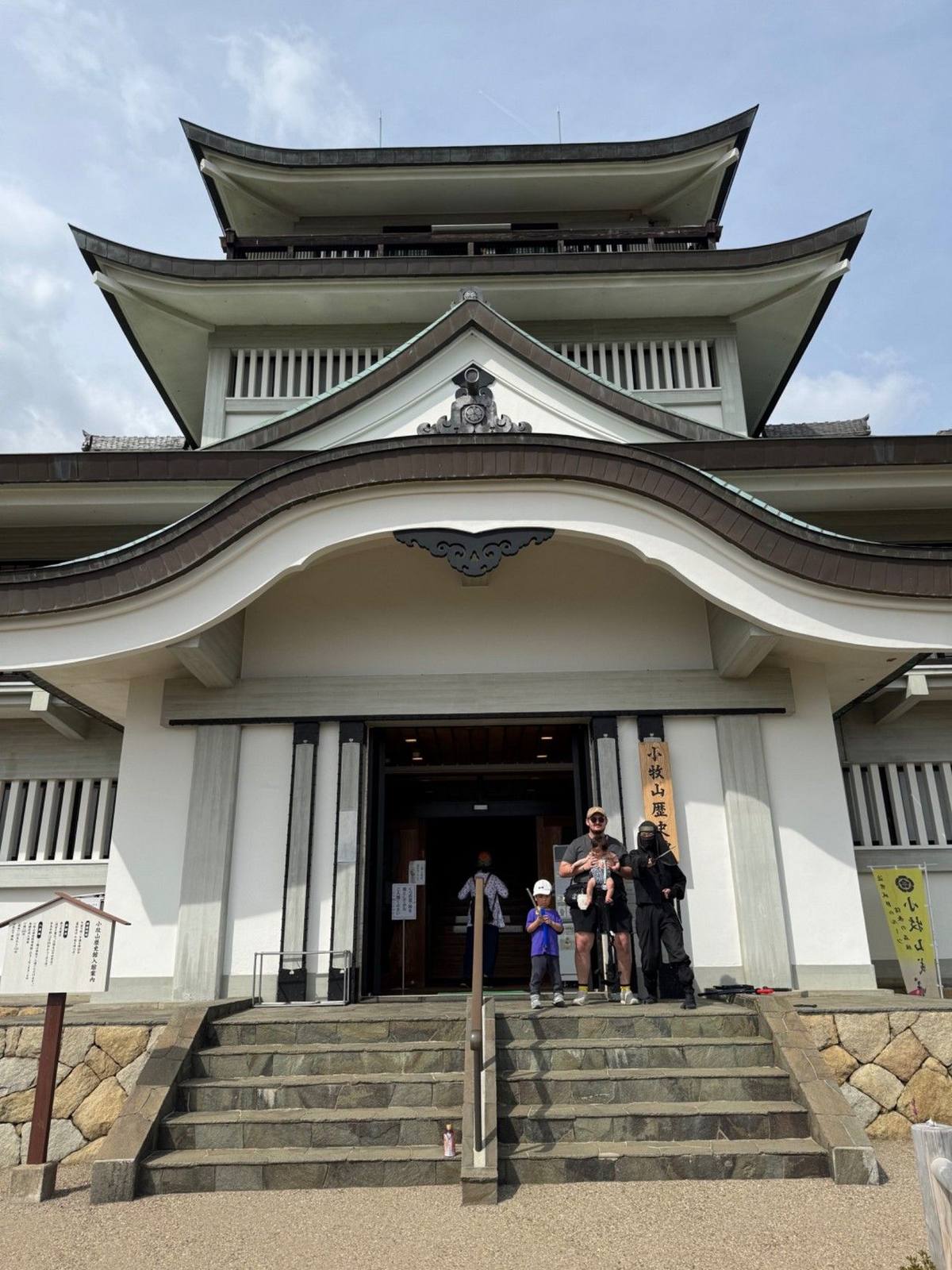
A family visit to a complicated mountain
When my family pulled into Komakiyama, there was no larger purpose behind the visit.
I remember getting out of the car and securing my youngest son against my chest in a baby carrier. My wife and our other son started up the mountain with me. We had visited castles before, and this was supposed to be another casual family outing: climb the hill, look around, enjoy the view, and go home.
At the time, I knew Oda Nobunaga's name more than I knew his history. Earlier that year, while visiting Atsuta Jingu with my parents, I had noticed his name among the stories surrounding the shrine. He was beginning to appear around the edges of the places I visited, but I did not yet understand how thoroughly his life was written into the landscape of central Japan.
I certainly did not arrive at Komakiyama thinking about sixteenth-century castle design. The steep climb, especially with an infant strapped to my chest, was more immediate.
Yet beneath that ordinary family outing was a remarkably complicated historical site. Komakiyama had served first as a new political headquarters for Nobunaga during his conquest of Mino and later as a fortified command position for Tokugawa Ieyasu during the Battle of Komaki and Nagakute. Modern archaeology has revealed that the castle Nobunaga created there was far more ambitious than its short lifespan once suggested.
I understood almost none of that on my first visit.
In retrospect, that is what makes Komakiyama an appropriate place to begin. I was seeing a castle site. I had not yet learned how to read one.
A castle pointed toward Mino
By 1563, Nobunaga's strategic position had changed dramatically from the uncertain early years of his rule.
He had moved his residence from Nagoya to Kiyosu in 1555, defeated Imagawa Yoshimoto at Okehazama in 1560, formed an alliance with Tokugawa Ieyasu in Mikawa, and largely consolidated his position within Owari. His attention could increasingly turn north toward Mino, where the Saitō clan still controlled the powerful mountain fortress of Inabayama.
In 1563, Nobunaga left Kiyosu and moved his residence to Komakiyama.
That decision matters because Komakiyama was not simply another inherited stronghold. Komaki City's preservation research identifies it as the first castle Nobunaga built himself rather than one he took over from earlier occupants. The mountain became the center of a new complex designed while he was actively campaigning against Mino.
The location made strategic sense. Komaki placed Nobunaga farther north than Kiyosu and closer to the territory he intended to conquer. But the scale of construction indicates that he was doing more than establishing a temporary forward camp.
South of the mountain, he created a planned castle town. Archaeological investigation has identified regular drainage systems and substantial residential compounds interpreted as samurai residences. Excavated ceramics and other material demonstrate that a community lived around the castle during Nobunaga's occupation. The town was not incidental to the fortress. It was part of the political landscape being constructed around it.
Nobunaga was therefore not merely moving soldiers closer to Mino. He was moving his seat of government. A castle, residences for retainers, merchants and craftsmen, roads, and the infrastructure supporting daily life were being organized around a new center of authority.
Even at this relatively early stage of his career, Komakiyama suggests that a castle could do more than defend a hill. It could organize the world below it.
Reading the mountain
The building standing at the summit today can easily confuse a first-time visitor. It resembles a Japanese castle keep, but it is not a surviving or reconstructed version of Nobunaga's original architecture. The present Komakiyama Historical Museum is a modern castle-style building.
The real historical evidence is underneath and around it.
Excavations of the summit have revealed multiple tiers of stonework surrounding the central enclosure. Archaeologists also found deliberate cutting and reshaping of the natural ground, showing that the summit was being engineered according to a planned design rather than adapted with minimal intervention.
This does not mean Nobunaga invented stone castle construction at Komaki. Japanese fortifications used stone before him, and the development of masonry was neither the achievement of one man nor a sudden technological revolution.
What Komakiyama shows is an unusually deliberate application of stone around the principal enclosure at an early stage of Nobunaga's career.
The construction process has even left behind traces of individual participation. One stone recovered from the summit bears the ink inscription “Sakuma.” Komaki City identifies it as the oldest confirmed example in Japan of an ink inscription on castle stonework. Researchers have proposed that it may indicate participation by a group associated with Nobunaga's retainer Sakuma Nobumori.
The significance of such a discovery is easy to overlook. Stone walls can appear anonymous. An inscription turns construction back into human activity. Someone had to quarry the stone, move it, organize labor, shape the earth around it, and decide where it belonged.
The main approach provides another clue. Komakiyama's principal route from the southern foot of the mountain ran directly uphill for a substantial distance before turning and becoming more complex nearer the summit. Excavation has confirmed that the builders substantially altered the natural terrain to create the route.
That approach is particularly interesting when compared with Azuchi Castle, constructed more than a decade later. At Azuchi, the famous Otemichi rises from the main entrance in a broad, strikingly straight line before continuing toward the principal enclosures.
The resemblance is suggestive.
But resemblance alone does not prove that Komakiyama was a direct architectural blueprint for Azuchi. That becomes the central problem in interpreting the site.
If Komakiyama led to Azuchi, why did Nobunaga leave?
It is tempting to describe Komakiyama as a prototype for Azuchi. The phrase is attractive because several features appear to support it: substantial summit stonework, a formal approach, a planned castle town, and the integration of political residence and military authority.
There is, however, an obvious objection.
Nobunaga did not move from Komaki to Azuchi. He moved from Komaki to Gifu.
If Gifu occupied almost a decade of his career between the two, then any theory of castle development that jumps directly from Komakiyama to Azuchi is incomplete.
There is also the matter of Komakiyama's short lifespan. Nobunaga occupied the castle for only about four years. In 1567, he defeated Saitō Tatsuoki, seized Inabayama Castle, renamed his new center Gifu, and abandoned Komakiyama as an active castle.
At first glance, four years might make Komaki seem unsuccessful. The opposite interpretation is more convincing.
Komaki had been positioned for the conquest of Mino. Once Mino was conquered, the strategic problem that had justified the move from Kiyosu had changed. Nobunaga could now shift his headquarters into the territory he had just taken rather than continue ruling from behind it.
Komakiyama was abandoned not necessarily because it had failed, but because Nobunaga's political geography had moved beyond it.
His castles followed his expansion.
The missing middle: Gifu
Gifu complicates any simple claim that Komakiyama directly produced Azuchi, but it also makes the larger developmental argument stronger.
Unlike Komakiyama, Gifu was not created entirely by Nobunaga. Inabayama had already been developed by earlier rulers, particularly the Saitō, and modern archaeological work has shown that parts of the complex Nobunaga inherited incorporated earlier construction. What he did after 1567 was modify, expand, and reinterpret an existing political center.
Excavation has revealed Nobunaga-period stonework associated with the summit complex, including evidence relevant to the development of the tenshu. At the foot of Mount Kinka, Nobunaga also developed an elaborate residential environment. Archaeology has uncovered gardens, decorative architecture, and gold-leaf roof tiles. Documentary evidence records Nobunaga receiving important visitors there, entertaining them with tours, performances, meals, and gifts. The castle was functioning not simply as a military headquarters but as a theater of political authority.
That development matters when considering Azuchi.
At Komaki, we see Nobunaga constructing a new headquarters, reorganizing a mountain, building a planned town below it, employing substantial stonework, and formalizing the approach to his central enclosure.
At Gifu, those ideas operated within a more sophisticated political environment. Architecture, landscape, gardens, decorative materials, and hospitality increasingly communicated authority.
Then came Azuchi.
Komaki, Gifu, Azuchi
Nobunaga began constructing Azuchi Castle in 1576. By then, the difference between the Nobunaga of 1563 and the Nobunaga of the late 1570s was enormous.
The man who built Komakiyama was an Owari warlord preparing to conquer Mino. The man who ruled from Gifu had entered Kyoto and become one of the most powerful political figures in Japan. The man who built Azuchi commanded territories, resources, craftsmen, and political authority that would have been unimaginable when construction began at Komaki thirteen years earlier.
His castles changed because his position changed.
For that reason, the development should not be reduced to a claim that Komakiyama was simply a smaller Azuchi. A more useful model is this:
Komakiyama: experimentation
A newly constructed headquarters, planned settlement, deliberate summit engineering, substantial stonework, and formal access toward the lord's central enclosure.
Gifu: refinement and expansion
An inherited medieval stronghold transformed into a political center where architecture, residence, display, hospitality, and monumental construction increasingly worked together.
Azuchi: culmination
A purpose-built seat created when Nobunaga possessed the resources to express those political and architectural ideas on an extraordinary scale.
This is not a rigid evolutionary ladder. Nobunaga did not simply copy one castle into the next. Different terrain, enemies, political circumstances, and resources required different solutions.
What connects the sites is not identical architecture.
It is the expanding conception of what a castle could do.
A second castle on the same mountain
Komakiyama's story did not end when Nobunaga left in 1567.
For seventeen years, it ceased to function as an active castle. Then the political order Nobunaga had constructed collapsed around his death at Honnōji in 1582.
The struggle over his legacy eventually brought Hashiba Hideyoshi into conflict with Nobunaga's son Oda Nobukatsu, who turned to Tokugawa Ieyasu for military support. In 1584, their confrontation returned Komakiyama to the center of events.
Ieyasu did not need Nobunaga's former residence. He needed a fortress.
In March 1584, Ieyasu ordered Sakakibara Yasumasa to strengthen Komakiyama. Large earthen ramparts and ditches were added, entrances were altered, and earlier features were buried or incorporated into the new defenses. Komaki City notes that many of the conspicuous earthworks surviving on the mountain today belong to this 1584 phase rather than Nobunaga's original castle.
This creates one of Komakiyama's most interesting interpretive problems. The visitor is not walking through one castle. The landscape contains two.
Near the summit, archaeological excavation reveals Nobunaga's residence and its early stone construction. Across other sections of the mountain, the visible earthworks speak more clearly of Ieyasu's military headquarters.
The first Komakiyama was constructed by a ruler pushing north. The second was fortified by a commander preparing to hold his ground against Hideyoshi.
The Battle of Komaki and Nagakute itself produced no simple final battlefield victory. Ieyasu achieved important tactical successes, especially around Nagakute, but Hideyoshi's power remained intact. By late 1584, Oda Nobukatsu had reached an accommodation with Hideyoshi and the broader conflict wound down.
Komakiyama was abandoned again.
Yet this later campaign helped determine what survived. During the Edo period, the Owari Tokugawa treated the mountain as a revered site associated with Ieyasu. Restrictions on access helped preserve many of its ditches and ramparts. Ironically, the Tokugawa memory of Ieyasu helped protect a landscape beneath which archaeologists would eventually rediscover Nobunaga's earlier castle.
One historical layer had obscured another. It also helped save it.
Learning to read the mountain
None of these distinctions were clear to me when I first climbed Komakiyama.
I saw paths, slopes, stones, earthworks, and a castle-shaped building at the summit. I did not know which features belonged to Nobunaga. I did not know which belonged to Ieyasu. I did not look north and understand why Mino mattered. I did not think about Komaki in relation to Gifu, or Gifu in relation to Azuchi.
I was carrying my son up a steep mountain with my family because visiting a castle sounded like something fun to do.
That gap between seeing a historical site and reading one has become increasingly important to me.
A surviving castle tower immediately provides something recognizable. Walls have height. Gates have shape. Buildings create rooms through which visitors can walk.
Ruins demand something different.
A flattened terrace means little until one understands what stood upon it. A ditch can look like a depression in the ground until it is connected to a defensive system. A road becomes more significant when excavation reveals that an entire hillside was reshaped to create it. A few exposed stones become more meaningful when they represent an early stage in the development of Nobunaga's castle building.
Even the absence of architecture becomes evidence.
Komakiyama helped teach me that a ruined castle is not an empty castle. The structure is still present. It has simply moved into the landscape.
Looking back, the mountain now occupies two beginnings.
For Nobunaga, Komakiyama marked a new stage in his expansion beyond Owari. It was a place where archaeology suggests he was already experimenting with the relationship between military architecture, residence, movement, settlement, and political authority.
For me, it marked an early point in the transformation of castle visiting from casual sightseeing into historical investigation.
Nobunaga stopped being only a famous name. His life became geographical.
Kiyosu led to Komaki. Komaki led to Gifu. Gifu led toward Kyoto and, eventually, Azuchi. Ieyasu and Hideyoshi became attached to those landscapes as well. The more castles I visited, the more the Sengoku period stopped looking like a sequence of famous names and battles and started looking like a network of actual places.
Komakiyama is valuable precisely because it resists a simple story.
It was neither merely a temporary fortress nor a miniature Azuchi. It was a short-lived but ambitious political center constructed at a particular stage of Nobunaga's rise. It was abandoned when his frontier moved. Its ideas were modified under different conditions at Gifu and eventually expressed on a far greater scale at Azuchi.
Then another generation reused the same mountain for an entirely different kind of war.
When I first climbed Komakiyama, I did not know how to read any of that.
The mountain was already telling the story. I simply had to learn its language.
Sources and notes
This article draws primarily on local-government archaeological and preservation materials rather than popular retellings.
- 1Komaki City Board of Education, materials on the Historic Site of Komakiyama, including site history, excavation reports, preservation planning, and the 1584 Komaki-Nagakute campaign.
- 2Gifu City, excavation and interpretation materials for Gifu Castle, including Nobunaga-period summit stonework and the residence complex at the foot of Mount Kinka.
- 3Shiga Prefecture, archaeological and preservation materials for the Special Historic Site of Azuchi Castle, including the Otemichi and principal enclosures.
See it in person
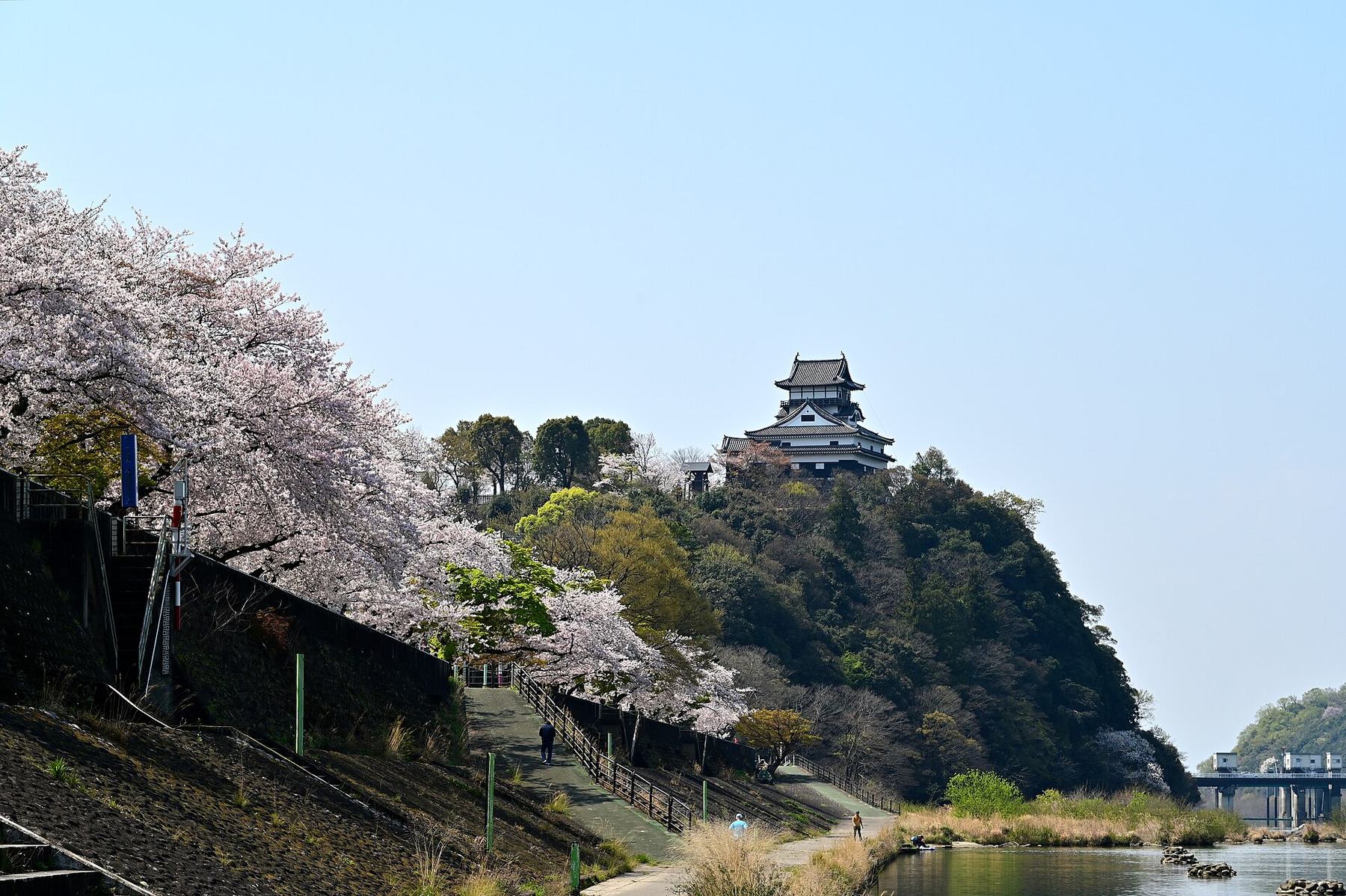
Photo: Bariston, via Wikimedia Commons
Inuyama, Aichi
Inuyama Castle Historical Walking Tour
Explore one of Japan's surviving original castle keeps and the history of Inuyama's castle town, its architecture and its strategic significance.
- Duration
- Approximately 4–5 hours
Next in the Journal
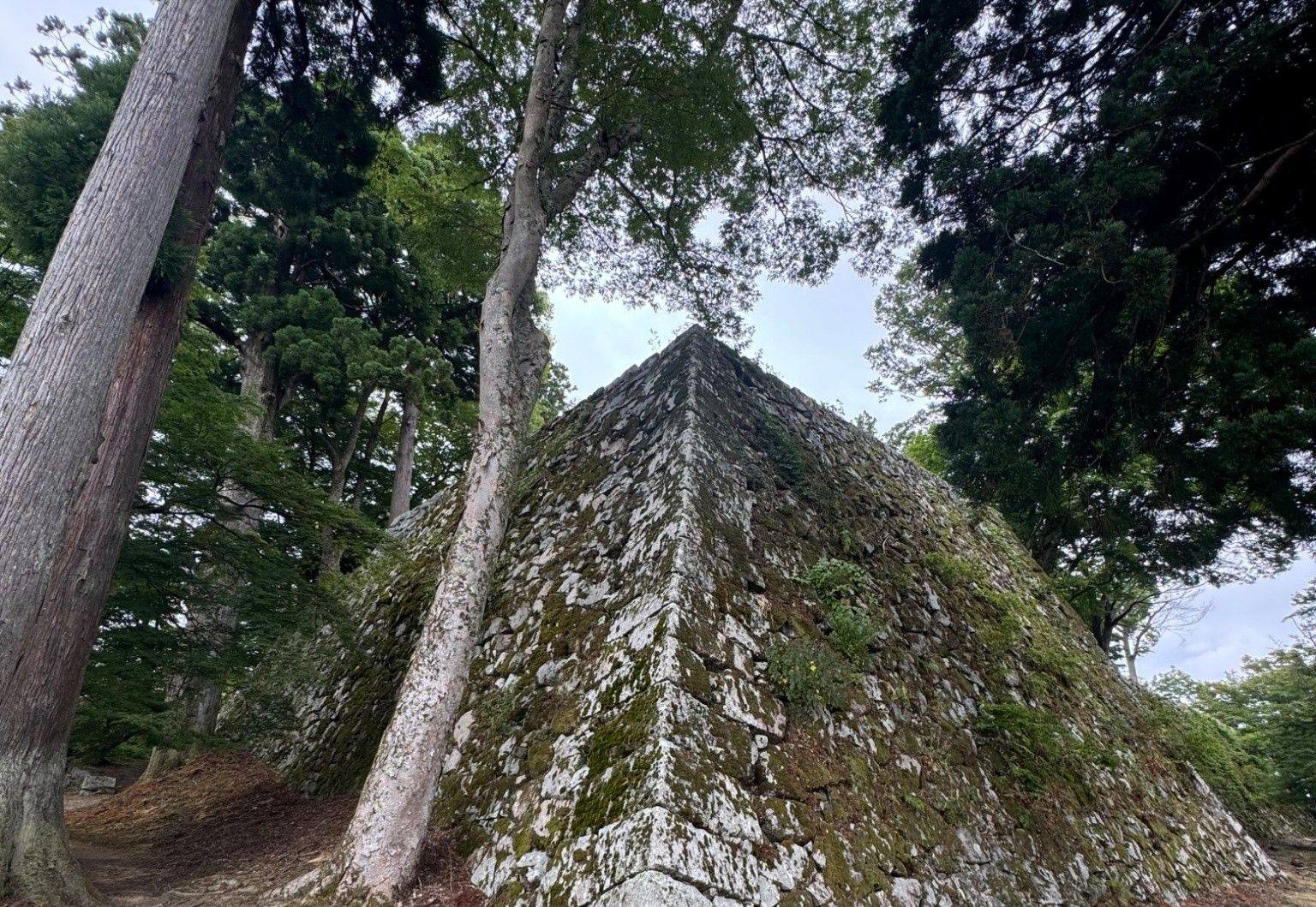
Castles1332 – 1873
Nothing Is Here, But Everything Is HereTakatori Castle and the Metropolis on the Mountain
A field essay on how Takatori reveals its scale slowly, and why the absence of its buildings makes the castle stronger, not weaker.
6 min read